Pages

Sunday, 14 August 2022

Migration is so exciting!!

 August is advancing and it's fascinating every time we set up at Belvide to realise the scale of the movement of migrants as they embark on their epic southward journey--what a priviledge!!

Our start times are early and to be honest the bright sunshine doesn't do us any favours as it shines on the nets making them visible to the birds. On the flipside however, it provides us with some wonderful sunrise views like this.....

Having said that the sun is no friend, we nevertheless have had some great catches and so far into August we have ringed over 700 birds from all our sites. Most of them have been migrant warblers so I thought I'd simply provide a gallery with notes of some of the birds we ring.

This is one of the small 'leaf warblers'--the commonest one of at Belvide is the Chiffchaff of which this is a nice example. They are difficult to distinguish from Willow Warblers but although there are some definitive pointers in the hand, 'Chiffies' are generally a bit smaller, duller and shorter winged that Willows.

Although this looks similar it's one of the bigger 'Sylvia' warblers--it's a Garden Warbler and is probably the least well marked of any warbler.

This is another of the Sylvia warblers and it's a Common Whitethroat. You can see the white throat but the most obvious ID feature is the chestnut areas on the wings,

This next bird is pretty nondescript but it's a real prize given we only catch a couple on average each year. This is the third one this year, and it's a Grasshopper Warbler
As you can see they are pretty sombre looking--but this next view really helps.....
The group of warblers they belong to all have rounded tails. The group are called 'Locustella' as they tend to have a song similar to grasshoppers/locusts, and are more often heard than seen.

Finally for now, there is a group of smallish brown birds called 'pipits' and one of them which is a long distance migrant is the Tree Pipit. We had heard a few calling as they do on migration and fortunately one popped into a net...


For now, I'll leave you with the picture because in a few weeks time a close relative-the Meadow Pipit will be passing through so I'll go over their ID features when I can compare them.


Sunday, 31 July 2022

They are on the move already!!

 As I write this, July has not come to an end, but we are seeing lots of evidence of birds starting their southward migration. This is often preceded by a bit of general wandering --believed to be a means of searching for suitable nesting areas when they return next year.

Yesterday we were very pleasantly surprised to catch a very young juvenile Redstart:-

You can tell it's a REdstart by the superbly russet coloured tail--but the body has not yet developed any of the typical Redstart colours. This is because it is a recently fledged bird showing the speckled appearance just like the baby Robins I have shown you in previous notes. So, where did this bird originate--answer we don't know. Feasibly one could argue that it's probably from nearby breeding site--Cannock Chase or East Wales--but in truth we don't know. What is certain is that it's migration behaviour has started and it will be on it's way to sub Saharan Africa any day now.

We don't have Lesser Whitethroats breeding at Belvide, although they are in the lanes around the reserve. These are one of my favourite warblers and this picture shows off its pristine post fledging plumage....
When these birds leave the nest they have a rather poor quality plumage on the breast in particular. Shortly after fledging they replace these with the pure, dense, white plumage you see here. Fantastic little birds--and quite unusual in that rather than take a south/south west route to Africa; Lesser Whites, fly south east and cross the Med Sea towards Egypt.

Each month team member Sam trawls through the BTO records looking for records of birds that we have encountered. This month there was one in particular which was worthy of special mention--a bird  Reed Warblers originally ringed at Belvide....

Ring number Z203549 was ringed on 31st July 2015, and we recaught it on 2nd July this year--2527 days after originally being ringed. So this bird was at least 7 years old, meaning that it had successfully completed 7 migrations to and from Africa!! Just looking at the actual migration flights alone this would entail somewhere around 150,000 miles--assuming it flew in a straight line ( which they don't!!). When you add on the daily feeding , breeding, other flights this bird will have racked up an incredible mileage--even without an annual MOT test.......

Speaking of birds replacing their initial set of feathers after leaving the nest, Pat out at Siskin City, has been catching quite a few juvenile Siskins looking like this one....
You can quite clearly see the yellow chest feathers coming through to replace the fledgling white feathers, which will give these birds their characteristic bright yellow underside when they've completely grown through.

As I've said, migration is well under way, and we have ringed over 1,000 birds in July! Assuming things go according to plan, this should be at least repeated in August--more news soon.


Sunday, 24 July 2022

Quality and Quantity

 This is the beginning of such an exciting time of year--and it comes round every year!! Breeding is coming to an end and migration is just getting started so anything can turn up amongst the big numbers of juvenile birds which are leaving the safety of their nests.

A couple of days ago Paul hit the jackpot with this little beauty......

This is a Lesser Spotted Woodpecker--just note how small it is--not much bigger than a sparrow! Next time anyone suggests they have seen a Lesser Spot, just ask them how big the bird was--most often they have seen a Great Spot. This is a juvenile bird as can be seen by the merest hint of pink on the forehead. Adult males have a red cap and females no red. Only a handful of these birds are ringed each year; not only are they quite rare, they tend to inhabit the tops of high trees. Fortunately this one found one of our nets--what a diamond bird!!

Now something less rare but quite interesting I hope....
These are both the same species!! They are both juvenile Willow Warblers. However, the bird on the left has gone through a post fledging moult and as a result the chest and belly are covered in these lemon yellow feathers. The other bird is a bit younger and is only just starting this moult. You can see some of the yellow feathers coming through to replace the rather drab grey fledging feathers. These are one of the first species to start migration so we are pretty sure when these appear--as tey did this week, tat things are on the move!!
How smart is this adult Moorhen!? Larger birds like this don't often stay in our nets--they flap and roll out very easily. However, we have a variety of walk-in traps which are much more effective, especially when they are baited with food the birds find irresistible.

I will try to keep up, but we are very busy trying to keep up with a large number of birds passing through, but I promise I'll try.......who knows what will turn up next?


Friday, 8 July 2022

Babies everywhere!!

 The start of July heralds the start of the main season at Belvide and other sites we operate at, such as Witches Oak near East Midlands Airport. Although some birds may still be breeding with second or thirds broods, the majority of breeding is finishing and migration is about to start.

The birders at Belvide reported seeing lots of family parties in the netting area so we were optimistic as we started our season. As it turns out we have had three very good sessions already and ringed over 200 new bird--over 90% of which have been juveniles pointing to an excellent breeding season. Ben has had two sessions at Witches and he also has had lots of juveniles in his 100+ total. More of this in the near future.

For now, I'll carry on the theme of the last blog and show some pictures which I hope are of interest by illustrating some of the things we get to see and use as clues to identity.

First a very familiar bird, the Barn Swallow. Two things about this bird....first it is an adult ( more than 1 year old) as seen by the deep red on the throat and forehead ( creamy buff in juveniles)--and the extra long tail streamers show this to be a male. The streamers are much shorter in females and hardly any length in juveniles.
Next another very familiar bird--a robin. This is a juvenile as you can see from the brown speckled throat and head, as we have mentioned in previous notes. However, this bird is now moulting out these juvenile feathers and replacing them with the much more familiar red breast feathers. As soon as these grow fully through the bird will be 'encouraged' by it's parents to move out and set up it's own territory.
Here is a Goldfinch which many of you will have on feeders at home. This is a male as shown by two features......most obvious is the fact that the red patch extends beyond the eye both above and below the eye. Second and a bit less obvious is the very thin hair like feathers at the point where the beak joins the skull. These so-called nasal hairs are black in a male and cream in a female.
Now on to a couple of problems that birds have.....

This Goldfinch clearly has some kind of bacterial, fungal or viral infection in the skin of it's feet--resulting in these enlarged growths. What is less familiar to us is the extra long growth of the claws as a result of the infection. Kevin reports the bird to be otherwise in good health. It's prudent after handling such individuals to thoroughly clean hands to avoid passing on the infection.
This young warbler shows very obvious growth or fault bars in it's tail. Lots of birds show these and they are as a result of changes in diet at particular points--poor food quality, shortage of food during adverse weather are two classic examples. In this particular case it enables us to tell that this is a juvenile ( newly fledged) bird--but how? You can clearly see that the lines are parallel which shows that the problems occurred while all the tail feathers were f growing at the same time--ie as the feathers do during time in the nest. If this occurs during tail moult in adult birds there would be a step between each pair of feathers, because usually the outer feather on each side moults first followed by the next inner then the next and so on.

More soon........


Monday, 27 June 2022

Mixed Bag

 Group members and friends are continuing to exploit as many opportunities as possible as we prepare for our annual 'main event' at Belvide reservoir. Here are a few snippets from our activities.......

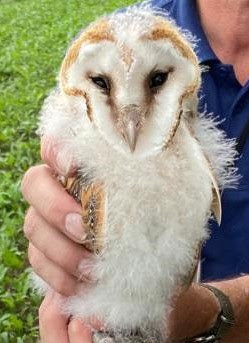
First our friend Roger has a special licence which enables him to check and ring Barn Owl chicks in the many nestboxes that we and others put up in the area.

One of our boxes on BPF had birds in them but when we first checked a couple of weeks ago they were too small. This time they were large enough to ring but still too downy to see the pattern of breast feathers which would have enabled them to be sexed...

Yesterday at another farm, there were three chicks and as you can see they were quite a bit older and had lost almost all their down....
 Staying with BPF, the feeders have become much busier as newly fledged birds--especially Great Tits have found an easy supply of food. This Blue tit seems to be developing well even though it has a deformed 'crossed' bill...
It's quite remarkable how many such deformities we see, with apparently healthy outcomes. I suggest the easy food such as fat balls may have some part to play in their success....
Lots of baby birds means lots of potential food for Sparrowhawks.....This is a bird we originally ringed as a youngster in spring 2021, which we retrapped a couple of days ago.
It's showing the orange eyes which this species develops as it gets older, as opposed to the bright yellow eyes in juveniles. The next picture shows a couple of the needle-sharp talons of this species--lethal weapons when they puncture skin, blood vessels and organs--it's these not the beak, which despatches most prey items.
An adult male Great Spotted Woodpecker was an unexpected catch as we thought we had ringed all the adults coming to the feeder. This picture shows the red patch at the back of the head which males have--plain black in females.
Meanwhile out in mid Wales, Pat is have a bit more variety in his garden catches. here is a female Blackbird showing the brown blotches on a grey breast of the female--very different from the black blotches on a white breast in the Song Thrush.
Finally, this morning dawned damp and cool so I popped down to Belvide to see if there were any Swifts flying low enough to catch. Bingo! I caught 17 before torrential rain stopped play. Here's a Swift showing the plain brown plumage ( which looks black as they hurtle through the air)


Tuesday, 14 June 2022

Spot the baby.....and the rarity!!

 It's been an interesting week with a highlight that didn't involve ringing!!

Team members have been plugging away in gardens and feeding stations making the best of the available birds. Attendance at feeders is increasing, mainly because young, newly fledged birds are finding feeding stations a good source of 'easy' food. So I thought I would show a few of these very young birds, which you will see in your gardens, and illustrate those features which identify these birds as newly fledged,

You can tell that this is a Goldfinch because of the bright yellow patch on the wing--but there is no characteristic red, black and white pattern on the head. Instead the head and breast are mottled brown and cream. Without the red/black, these birds don't pose a threat to the adults ( and their parents) so they continue to be fed and protected. In a few weeks, the colours will grow through and the youngsters will gradually be shunned and sent off to look after themselves.
It's almost exactly the same for this baby Greenfinch. The mottled breast and lack of intense green colours are typical and serve the same purpose as in the Goldfinch.
This is a bird misidentified so many times!. It's a newly fledged Robin. The lack of a red breast avoids aggression as above. As the red feathers grow in these youngsters will get more able to fend for themselves.

Yesterday I visited Belvide reservoir to see if there were any Swifts low enough to be caught. Sadly there were none, but as I scanned the water I picked out what I was sure was quite a rare bird. Unfortunately I didn't have my telescope to clinch it and my binoculars weren't powerful enough. I phoned out for others to come with their optics but just before they arrived the flew off!! I felt terrible and none of the birders could find the bird despite an hour or so of searching.
Just as I was about to give up and go home, I spotted the bird in a different part of the reservoir and managed to get close enough to see it and identify it as a Red Necked Phalarope. A small wader which actuallt feeds by floating on water and picking insects off the surface. This one was an adult female....
They are absolutely gorgeous birds and a small number of pairs breed on the Shetland Isles. A good number of the local birders managed to come and see it too.


Wednesday, 8 June 2022

Home and Away

 I've mentioned previously that at this time of year it can be difficult catching large numbers of birds by conventional means because many are breeding and distributed more thinly on their territories. Out in mid-Wales Pat still has plenty of birds coming to his feeders from the many breeding pairs of Siskin in the surrounding area. For the rest of us it can be a lot of work for not much reward.

However, team members have been enthusiastically setting nets in their gardens, and catching birds such as this recently fledged House Sparrow in Kev's garden...

You can see the loose, fluffy plumage that young birds have--but you can also see the bright yellow flanges of the base of the beaks--the gape--again an indicator of juveniles.
Paul's also been regularly catching at the farm feeding station--and quite a few Stock Doves have been visiting. I though I would show a picture of the colourful patch on the side of the neck of this under studied species..
Feather colours are of two types. The first is where the feather has pigments embedded in the feather--but these feathers don't rely of pigments-they rely on the reflection and absorption of light. \as such, the colour can change--in this case they look green, but if the bird turns even a fraction they can look, blue or purple. That's the 'home' part of the title--so now let's look at 'away'.

Although we have lots of nestboxes at our sites, they are generally attracting Blue and Great Tits. Last year we inherited a nest box scheme in Herefordshire (ie away), which attracts exotic ( for us), species such as Pied Flycatcher and Redstart. Last weekend we had a delightful day ringing lots of 'Pied Fly' chicks with Gareth and his two beautiful daughters of 7 and 5 years old. Here's a picture of a brood of 7 healthy Pied Fly chicks
There was great excitement at one of the boxes when a female Redstart was seen leaving a box containing eggs. If they hatch and grow I hope to show some pics in a couple of weeks.

Our good friend Roger has a very large nestbox scheme also in Herefordshire and he generously allows members of our team to join him which gives them good experience. Jenni joined him at the weekend and they ringed over 100 Pied Fly chicks. His site also has breeding Wood Warbler and they managed to ring an adult bird. These are marginally bigger than a Willow Warbler--but they are much more striking in the amount of bright green plumage, with a striking yellow stripe over the eye ( supercilium ), and a bright yellow throat.

I hope to have more for you soon, as we build up to the start of the post-breeding/migration season at our sites.