Pages

Wednesday, 1 July 2020

A Cetti good start!!

As I mentioned in my last report, things have been a tad hectic at Belvide since the arrival of the Laughing Gull on Sunday afternoon. We've had lots of visitors to the reserve who generously donated almost £400 which we will be able to use to continue improving things for future visitors-and birds. Top birder Steve managed to get a picture of the Laughing Gull standing next to one of 'our' Black Headed Gulls which we colour ringed a couple of years ago and which has returned to breed. A pretty neat picture I think--with the Laughing Gull to the left:-

 
Last night we set the remaining nets for the 'Grand Opening' of the 2020 season this morning. Unfortunately this morning we were greeted at 05.00 with mizzle which seemed to dampen the birds' enthusiasm for getting busy. We had a slow start as a result but things picked up until we decided to call it a day ay 09.00.
65 new birds was a bit disappointing but actually, within that total there were some very interesting birds. As is usual for Belvide Sedge and Reed  warblers made up the bulk of the catch--but we did have a few special birds--see later...…
It's great to see so many newly fledged birds around, illustrating that it's been a decent breeding season-and in Sedge warblers in particular there is a plumage feature which birders can see using optics which allows you to age juvenile Sedgies. Most of the juveniles have a more or less well developed 'necklace' of dark brown speckles round the throat--the bird in this picture had a reasonablywell developed one as you can see:-
 
 
We don't catch too many Bullfinches at the res, so this smart male was both stunning to look at-as well as being instructive for the trainees:-
 
The smartness is obvious--but it needs a close look at the area near the joint of the wing to see a particular ageing feature:-
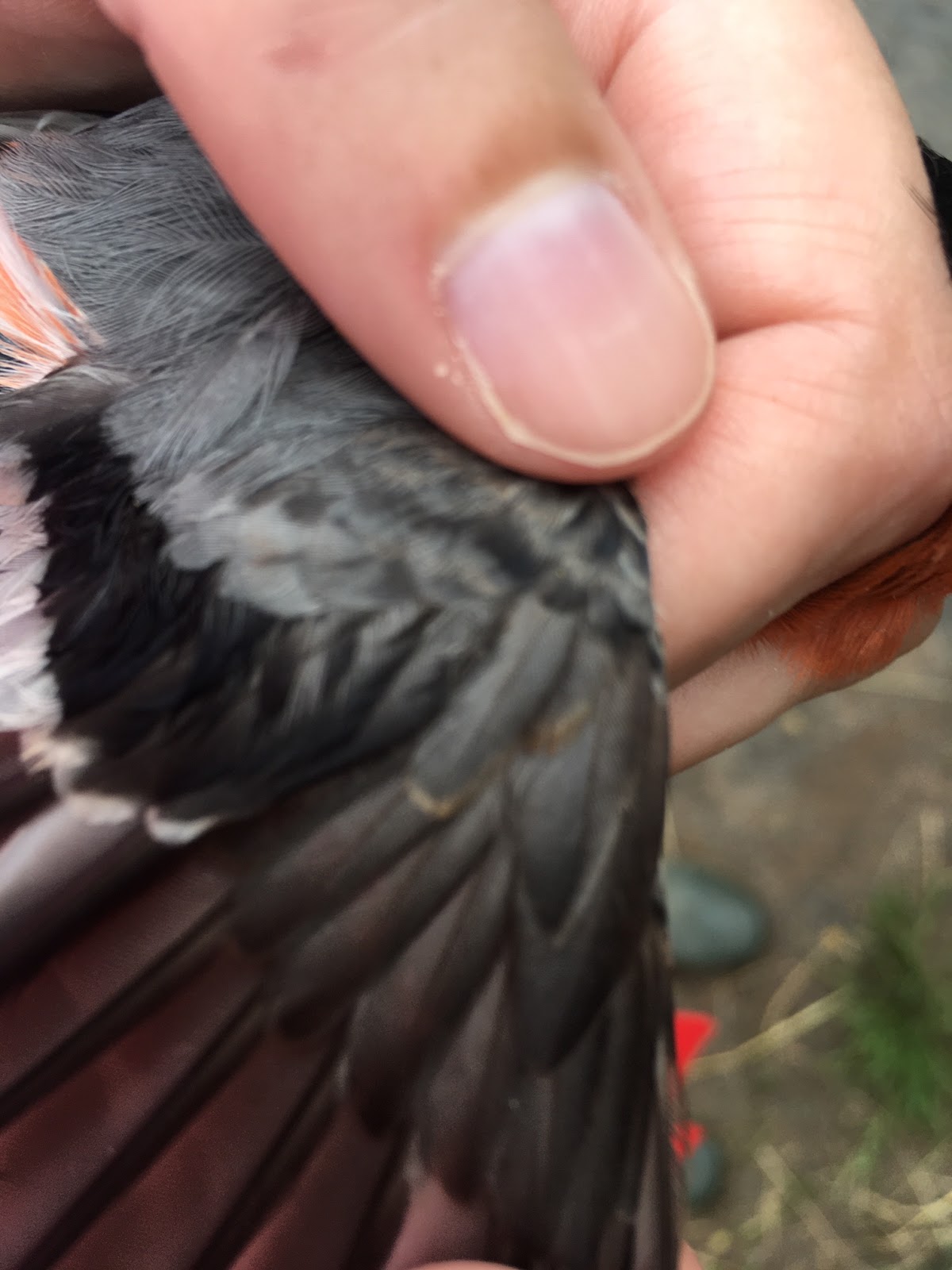
 
Just below the thumb of the holder you can just make out one longish feather with a pale buff tip-and next to it a shorter feather with a dark buff tip. Both these feathers have been retained since the bird was first fledged--so we know this bird was definitely hatched in 2019.
The following bird was definitely hatched just a couple of weeks ago--and causes some people headaches trying to identify the species...…
 
 
Of course this is a baby Robin which has only recently left the nest--the speckled breast will be replaced by red feathers over the coming months--these speckles are thought to reduce the potential aggression from adult males until these youngsters can properly fend for themselves.
 
 
This Blackcap is an intriguing bird. At first glance I thought it was an adult male because the head looked black. However, on closer inspection, the black feathers are just coming through as they replace the brown feathers which all juvenile Blackcaps have when they leave the nest. The date here is only 1st July, so this bird must have been fledged sometime in May for it to have moulted these head feathers to this extent.
Finally, for the more common species, this Song Thrush again shows an ageing feature which you can see in the field:-
 
 
If you look carefully at the buff tips to the feathers in the middle of the wing you can see the tips are shaped like a rose thorn going up the feather shaft. This is a juvenile feature and these tips in older birds are rounded instead of thorn shaped.
 
I reckon it's impossible not to be impressed by Kingfishers, and although they are relatively common they always provide a boost during a ringing session. This is our first for this season--it's a juvenile female-the developing patch of red on the lower mandible of the beak shows it's female:-
 
 
I couldn't resist showing you a picture of the wonderful blue streak down the bird's back--often all you see as it zooms past along a river or canal:-
 
 
And last but by NO means least, we have had a new breeding species on the reserve this year, called a Cetti's Warbler. To be fair they are not the most colourful bird on Earth--but we have waited a long time for this coloniser from southern Europe to set up its stall at Belvide. We manged to ring both adults and two of their chicks--we are pretty sure they are raising a second brood as I write.
 
 
This is the adult female--males look exactly the same but they are measurably larger. As you can see--not especially pretty-but interesting on many levels--one of which is that they only have 10 tail feathers--unlike the vast majority of songbirds which have 12. I have no idea why!!
Here's a closer picture of the larger male, where you can see a bit more of the head features:-


Looking forward to our next session on Saturday morning.


Monday, 29 June 2020

Two old favourites!!

Just a quick post script to the last message. In addition to the 41 new birds we ringed last evening--we had 8 already ringed birds ( we call them re-traps) all of which were carrying rings we recognised from previous years. It's always great to see these birds--especially bearing in mind that some of them have travelled to southern Africa and back to be with us again!!
However, two of these birds-both Reed Warblers, were extra special and fulfil the 'Old Favourite' category. They have both made that incredible journey at least SIX times. Even if we assume ( incorrectly) that they flew in a straight line during each flight, these tiny 13 gram birds have clocked up about 100,000 miles during their migrations alone--not counting feeding/breeding and all the other daily flights these birds make--INCREDIBLE !!

Up and Running--almost

Just a short post today. Last evening we set half of our nets at Belvide in readiness for the new season starting on Wednesday 1st July ( see later). We had 4 trainees with us so we decided that it would be a good idea to leave the nets open for a while to get the trainees back into the swing of things after the lay-off. For a late afternoon/evening session it went very well with 41 new birds--mainly warblers with 17 Sedge and 15 Reed making up the bulk. Of these there was a very encouraging number of juveniles, ie hatched this year--which we hope bodes well for the rest of the season.
Early on in the session while we were deep into the setting of nets, things took a rather surreal turn when ace birder Steve came running ( as best he could) past us shouting 'Laughing Gull gone to the Chappell Hide bund-- totally excited. After which there was a mini invasion of birders who had abandoned their Sunday tea to twitch the bird. Which was a first for Staffordshire. That gave us a chance to involve some twitchers in our ringing activities and show them some of the birds--always goes down well.
Which leads me on to the next few days. We will be setting the remainder of the nets in place on Tuesday and safely furling all the nets ready for our official opening on Wednesday morning. As in previous years we will be operating every Wednesday and Saturday mornings and WMBC members are warmly invited to join us from about 6.30 am. Just to clarify though--because of current restrictions we probably won't be able to involve visitors in quite the same way as usual--but we'll do our best!
Pictures of the birds coming in the next posts!!

Monday, 22 June 2020

It's tough out there !!

Habitats change--it's called 'succession' and it means that we constantly need to keep an eye on habitats to keep them suitable for the species we are interested in.
Some readers will remember articles on this site about Jack Snipe and the very valuable site we have which is very good for this species. However, I have been aware for some time that Willow is encroaching and if left this aggressive plant would take over the site and destroy its suitability for Jack snipe. Something needed to be done. Having explored all options with the manager of the land the remaining option was brute force.
So a call to arms went out to our group and friends and after three morning sessions over the last week, we have made a significant impact on the willows-especially in the area which the Jack and Common Snipe favour.
We know it's temporary but it will give us breathing space to work out a longer term solution. As you can see from the picture it was pretty back breaking work having to bend and snip every plant as close to the ground as possible--but all credit to the team -they worked brilliantly and produced an excellent result--a big THANKS from me on behalf of the snipe which will be arriving towards the end of September.
The team are hard at it and -yes that IS Glynn in the foreground who took party in EVERY session now that he is a fully converted team player...….( thanks Glynn)
This lovely group of Red Deer were just starting to move but as you can see even they stopped and did a double take just to check that it was Glynn there for his third session...….( thanks Glynn)
 
On a more sober note--the superb Reed Bunting nest I showed in a recent post was a victim of some of the torrential showers we've been having. The nest was on dry ground when we found it but unfortunately as you can see, after the rain it was in a small puddle and the eggs were now floating
It's a great shame--but ever resilient as birds are--the pair are still on the patch and by the look of their behaviour they have set up another nest site nearby--lets just hope it's a bit higher and drier!!


Kestrel partial success

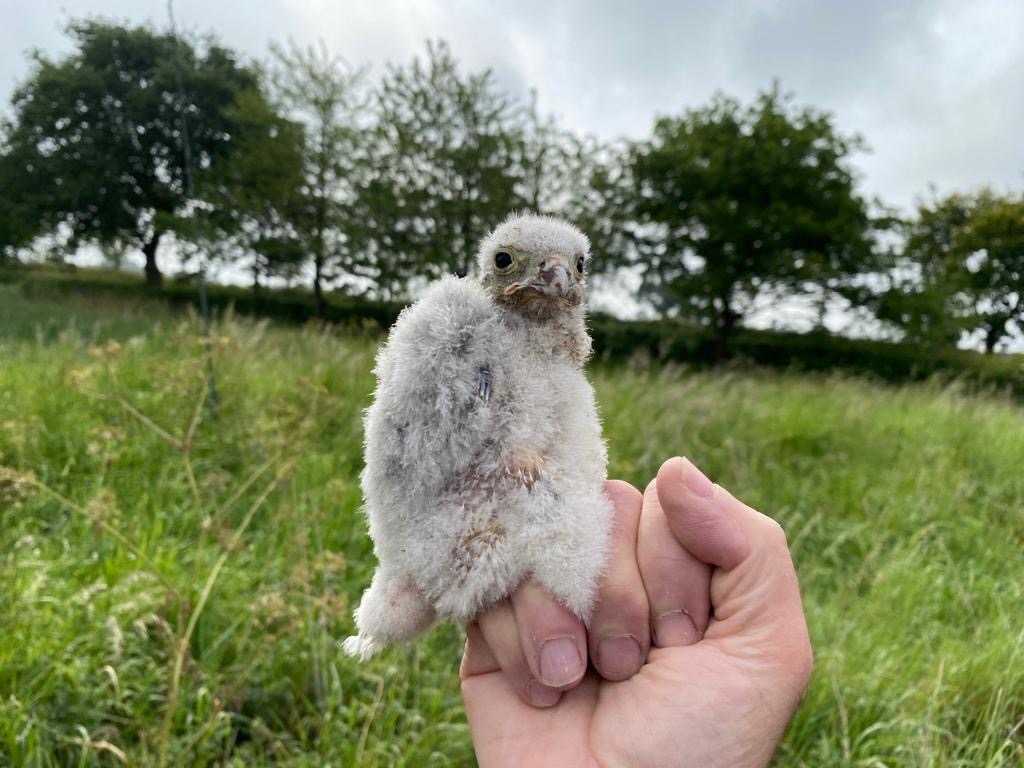
Last year we were really happy that our Kestrel pair in the nest-box was successful in producing 4 healthy young--and this year the same box ( with probably the same pair) produced 5 young. Unfortunately when we climbed the ladder to ring the chicks one of the 5 was dead. This often happens with birds of prey and owls-where the youngest chick is smallest and if food supply is short it perishes in order for the parents to maintain a food supply for the rest. A rather cold wet period must have reduced the food supply and the littlest one didn't make it.
However, the remaining chicks were very strong and left my hands in no doubt that they would soon be ready to hunt! Their claws are quite sharp and they know how to use them from an early age. This little one looks very imperious for a quick photo call:-
 
Based on the previous year's success we put up another box at the other side of this farm, and two more at another farm a little way away. Unfortunately none of these boxes had anything in them although we did see evidence of birds hanging around one of the boxes which did have a rudimentary nest scrape inside. It often takes a while for boxes to be used--especially when-as we think-it's an immature pair attempting to nest for the first time and them not being 100% sure how to go about things. we remain optimistic that next year we may have at least one mor occupied box.

Thursday, 18 June 2020

Birds are BEAUTIFUL !!

Just a couple of examples of this have happened over the last week or so.
First we tried a netting session for the first time at our new farm project. We had a decent if not spectacular catch, including several Garden Warblers and Blackcaps--but undoubtedly the star bird of the morning was this beauty!!:-
Many people will not recognise this bird because it's one that is more often heard than seen--it's a Cuckoo. And what a fabulous beast it is. They are larger than many people think, and in this picture you can certainly see the relatively long tail which gives it the look of a bird of prey when in flight. The next picture is a close up of the bird's head:-
The bright yellow eye ring is stunning. This is a male bird because it was 'cuckooing' before we caught it--the female produces a completely different bubbling call--which as it happens sends any males nearby into a frenzy to mate with her.
We're not sure which species these birds are targeting to lay in the nests of--there are no Reed Warblers or Meadow Pipits nesting on the farm so they must be looking for Dunnocks--or whatever parent species raised the particular female. These adults will be returning to Africa anytime soon, leaving their offspring to be raised by some foster parents. The youngsters will then set off to Africa on their own.

 
Yesterday, we arranged the first of three sessions of Willow removal from an important site that certainly doesn't need Willows. Shortly after we arrived I noticed a Reed Bunting shuffling away on the ground doing a 'broken wing' display. I've never seen a Reed Bunting do this ( a display to draw predators away)--probably because I've never seen a Reed Buntings nest in 50+ years I've been birding. It only took a couple of seconds to find the nest--which I'm sure you will agree is truly beautiful:-
It is a superbly constructed cup of grass stems on the ground with an exquisite lining of white hairs--taken from ????. In addition the eggs have a translucent grey background with dark red brown markings. As a kid we did find many Yellowhammer nests which I seem to remember as similar--but our nickname for the Yellowhammer was 'Scribbly'--after the appearance of the eggs. It looks like scribbled markings may be a character of bunting's eggs. we will keep an eye on the nest and hope th chicks fledge.
All together two beautiful birding sights!!
 

Monday, 15 June 2020

Reed Warblers-superb nesters!

This morning we managed to find the nest of one of the two pairs of Reed Warblers nesting on a small irrigation pool, which is developing a strip of Phragmites reeds round the perimeter. The nest was most unusual--every one of the (many) nests I've found over the years has been a simple brown grassy cup with no adornments inside or outside the nest. This one was very different:-
As you can see there's lots of white stuff mainly on the outside. Not quite sure what it is but it's s new one on me. We couldn't see what was on the inside because the chicks were well grown and filled the cup. We decided that if we had tried to ring the chicks they would probably have been very difficult to persuade to stay in the cup so we left them alone after the picture. A good learning experience for the trainees.
We couldn't find the second nest but it didn't really matter because the chicks had obviously fledged --one of which we caught in a nearby mist net:-

You can see the still growing tail, and the yellow flanges at the base of the bill which provide a very conspicuous "gape" when the chick begs for food--this provides a superb target for the parents to aim at with beaks full of food.
Just for good measure here is one of the adults we also caught nearby.

We hope these will be the first of many Reed Warblers over the coming months--of which more later.